
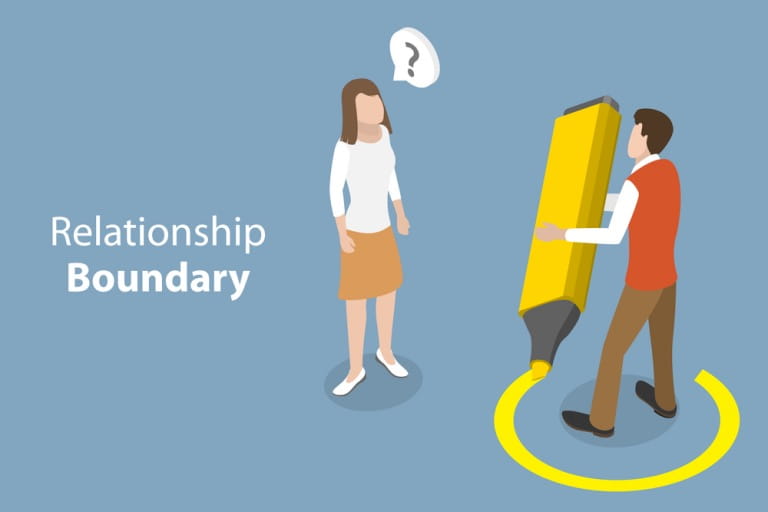
Many couples approach boundaries as a discussion they will have at some point, often after it is too late. Boundaries should always be a pre-conversation to any relationship. Knowing your lines and needs together circumvents fighting over them. It makes couple intimacy something you construct deliberately, not something you accidentally find yourself dealing with.
Why “mapping” beats “the talk”?
Have you ever had a single conversation about boundaries and felt relieved and that was that? Or did you feel like things were clearer for a little while, but then the onus to remember and enforce the rules was on you, and you started walking on eggshells right away because well now you know the line and you must be careful not to cross it, even if you’re not always sure where it is, and you’d really rather not spend all your time thinking about lines and simply enjoy the walk? What if together you could sketch out a map and divvy up the supplies for future mapping expeditions and make it fun?
Do the individual pre-work first?
The number one thing you may be doing wrong when it comes to having boundary talks is skipping this step. If you walk into a discussion not already clear on your own hard limits, soft limits, and curiosities, you are going to default to reacting to whatever your partner brings up rather than contributing anything real. Hard limits aren’t happening, and that’s that. Soft limits are things you might try under the right conditions or with the right warm-up, but also maybe not ever. Curiosities are the fun spot: things you haven’t tried but feel captivated by.
None of this can be your partner’s job to suss out for you. You need to sit alone with this for a bit first. Some people find it helpful to run through a structured self-assessment first, and if that’s you and you don’t know where to start, you can discover your compatibility profile before you try to compare notes with someone else. Nobody is asking you to memorize lines here. But you need to have gone through some of it yourself in advance so that you’re not genuinely finding your limits or your interests in real time, in the middle of a coffee shop, with your partner.
While you’re doing this, remember that some of these things are going to be really tied up with your attachment style and it can be helpful to notice that. Someone who is maybe higher in attachment and tends to need more reassurance could find themselves leaning toward soft limits on a lot of things that feel kind of emotionally distancing for them, for example. Someone who is maybe more on the autonomy end of the scale could have a general sense of, “Sure I’m curious about that, but I think anything that feels clingy or makes me vulnerable should be on my hard limits,” as a first guess. And that is FINE, but you can’t name it if you aren’t looking for it.
Turn the conversation into categories
After all, if a lover’s tendency to poke you in the ribs gently with their toes totally kills that post-coital glow of connection and you leave bed quietly seething, it’s hard to bring up without feeling like a nitpicky monster. Especially if you incorporated a lot of your partner’s preferences in your Yes column and now they know something you don’t like, it’s easy to feel like some kind of broken pet they’re trying to train.
But claiming your mild sensitivity to something is the bedrock of assertive kindness! It’s a way of saying, “I trust you with my comfort and pleasure, and you trust me with yours, and wanting you to be comfortable is not a burden to me.”
Expect mismatches, and don’t treat them as failures
There will be things where one partner is a hard yes and the other is a hard no. This is okay, not an indication of incompatibility. The play here is to isolate the desire from the person. Desiring something your partner won’t do is not a character flaw, and declining something your partner desires is not a rejection of them. Name the mismatch out loud, grieve it quickly if you must, and move to the next item. Don’t stare at it for a long time trying to negotiate somebody out of a hard limit. That’s where trust dies.
Maintain the map, don’t just draw it once
Desires and boundaries may change over time, so it’s important to have regular check-ins. According to research on stable relationships, there are roughly five positive interactions for every negative one in couples who are happy long-term. Check-ins may not be sexy but they are how you keep that ratio in your favor.
After having a boundary discussion, check in with your partner soon after. Sometimes feelings or realizations come up after we’ve had time to process and you want to make sure everyone still feels good with where the boundary is set. Vulnerability hangovers are real, even outside explicitly kink-related discussions. A short debrief, a bit of physical closeness, or just naming that the conversation felt hard goes a long way toward making the next one easier to start.
A boundary map doesn’t replace a relationship with no conflict. What it gives you is a shared reference point, so the next hard conversation starts from agreement instead of guesswork. Build trust into your boundaries and the process of setting them by showing up honestly and kindly in those discussions.